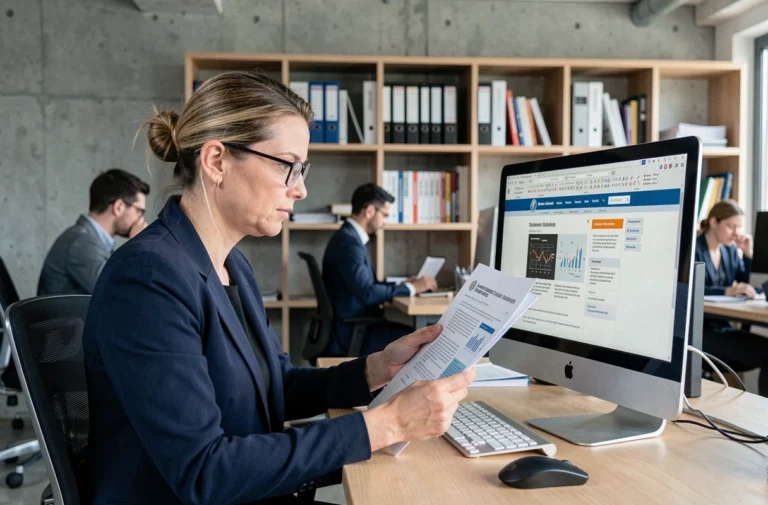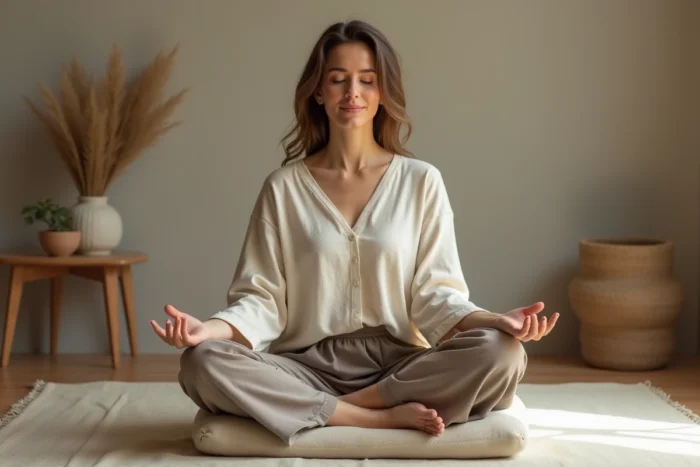
We’ve all experienced that moment when, after a day filled with demands, we finally sit down and realize that our brain is still running at full speed. Thoughts overlap, the body remains tense, and the very idea of calm seems abstract. Meditation and personal development offer concrete tools to break this cycle, but their effectiveness largely depends on how we integrate them into our real habits, not in an idealized framework.
Cognitive distancing: observing thoughts without forcing calm
Trying to “empty the mind” is a common instruction in guides on inner peace. In practice, it often has the opposite effect: we tense up trying not to think, which generates frustration.
A more practical approach is to practice cognitive distancing rather than forced immersion. We observe a repetitive thought as an external object, without trying to eliminate it. We can ask ourselves a simple question: “Does this thought help me act now?” If the answer is no, we let it pass.
This self-questioning can also be practiced outside of formal meditation, during a wait in line or a commute. Awareness of our thoughts doesn’t require a cushion or a timer. Several personal development practitioners use this technique to defuse ruminations before they settle in, and accessible resources on https://nouveau-rivage.com/ allow for a deeper understanding of these mechanisms in daily life.
Feedback varies on this point: some people find distancing natural, while others need several weeks before feeling a gap between thought and emotional reaction. No method works the same way for everyone.
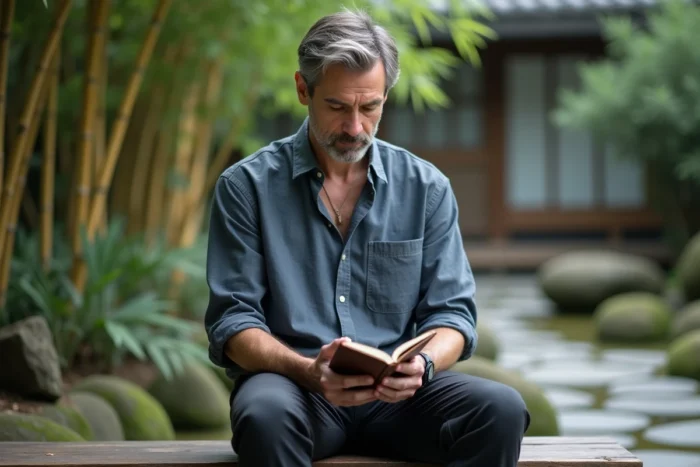
Meditation and routine: building a practice that fits into a real schedule
The main obstacle to meditation is not a lack of motivation, but a lack of time slots. We know we should start, but between waking up, the kids, work, and meals, the ideal moment doesn’t exist.
Anchoring the practice to an existing gesture changes the game. We meditate just after brushing our teeth in the morning, or just before starting the car. No need to block off an extra time slot: we attach the practice to an automatic habit.
Short sessions rather than long ones
A few minutes of conscious breathing after the morning coffee produce more regularity than a long weekly session that we end up canceling. Consistency outweighs duration.
- Box breathing (inhale, hold, exhale, hold, each phase at the same tempo): usable while sitting at your desk, without anyone noticing
- Quick body scan: mentally moving from feet to head identifying areas of tension, which takes less than three minutes
- Active listening to the environment: closing your eyes and mentally naming each sound heard for one minute, which brings attention back to the present
These micro-exercises do not replace an in-depth practice, but they build the reflex. The body and nervous system begin to associate these gestures with a state of calm, which then facilitates longer sessions.
Meditation apps: a tracking tool, not a permanent crutch
Platforms like Insight Timer have transformed how we settle into a meditation routine. Reminder functions, practice statistics, support groups: gentle gamification helps maintain consistency over several months.
We can track our practice frequency, identify the days we drop off, and adjust. This tracking makes visible a progress that would otherwise remain purely subjective.
When the app becomes a hindrance
The risk is confusing the tool with the practice. Checking meditation statistics can become an additional source of stress if we turn serenity into a performance goal. Medicating without a screen remains the skill to develop in the long run.
A good use consists of using the app during the first few weeks to establish the rhythm, then gradually spacing out guided sessions in favor of moments of unassisted silence. Personal development also involves the ability to do without the tools that helped us get started.
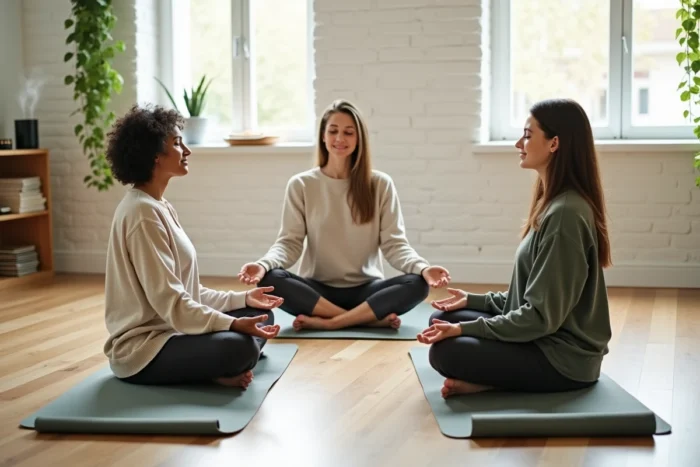
Personal development in the workplace: meditation as a professional skill
Stress management and emotional awareness are now included in the soft skills training catalogs of many companies. It is no longer a topic reserved for the private sphere.
Centering exercises can be practiced during the workday without being perceived as an unproductive break. Some organizations integrate collective breathing times before meetings or offer dedicated spaces for calm.
- Conscious breathing exercise before speaking: reduces physical tension and clarifies speech
- Two-minute break between two complex tasks: allows the brain to exit reactive mode
- End-of-day journal (three sentences about what went well): cultivating awareness of positive emotions strengthens the ability to manage negative ones
This professional integration has an interesting collateral effect: it normalizes the practice. When meditation is part of the company’s vocabulary, people are less hesitant to adopt it in their personal lives.
Link between training and individual practice
A personal development training provides a framework, but inner peace is built in the repeated gestures between sessions. The real work begins when we close the training notebook and return to face our thoughts, alone, in the evening silence.
Meditation is not a skill that we validate once and for all. It is a daily exercise whose effects on stress and serenity are measured in months, not days.