
A mass of perennials that withers after two seasons, a terrace that seems randomly placed, outdoor lighting that dazzles more than it enhances: these situations reveal a gap between decorative intention and the technical reality of the land. A professional decorative gardener intervenes precisely at this junction, where personal taste meets the constraints of soil, climate, and regulations.
Prior declaration and development tax: the administrative trap of decorative projects
Do you think you can install a pergola or a garden shed without any formalities? The line between outdoor decoration and regulated structures is thinner than one might imagine. In 2026, several sources remind us that fences, shelters, pergolas, and carports are treated as regulated structures as soon as they alter the footprint.
Specifically, surface thresholds determine the level of formality: no action required, prior declaration, or building permit. A simple enclosed and covered garden shed can trigger the development tax, and forgetting to declare can sometimes lead to late regularization with penalties.
This is an angle that landscape professionals know well. An experienced decorative gardener, like Le Jardinier Décorateur, incorporates these constraints from the design phase to avoid administrative surprises. This upfront verification saves time and protects the overall project budget.
Custom landscape design: from site diagnosis to planting plan
Why can two neighboring gardens with the same plants yield radically different results? Because the soil, exposure, and microclimate can change from one plot to another.
Site analysis as the foundation of the project
A decorative gardener starts with a site diagnosis. They observe solar orientation at different times, identify shaded areas cast by existing buildings or trees, and assess the nature of the soil. Clay soil will not retain water in the same way as sandy soil. The choice of plants directly stems from this reading of the land, not from a catalog.
This step conditions everything that follows. A flower bed installed in a poorly drained area will eventually rot. A hedge planted too close to a property line can pose a legal problem.
The planting plan and the staging of volumes
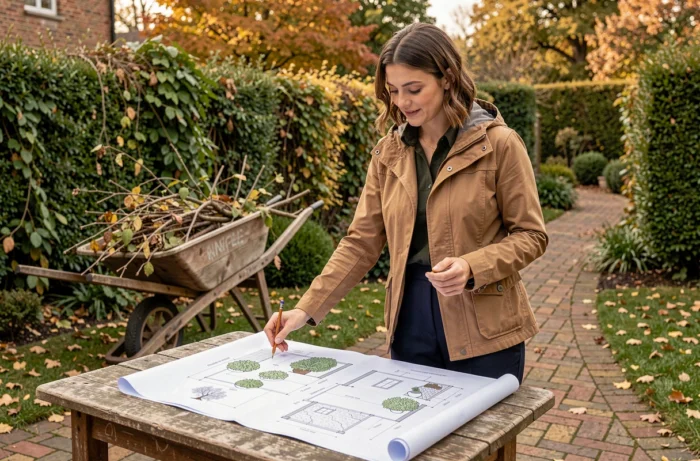
The professional then draws a plan that organizes the plants by layers: ground cover, medium shrubs, structural trees. The goal is to create visual depth, even in a small space. Three principles guide this composition:
- Alternating foliage textures (broad leaves, fine grasses, evergreens) to maintain visual interest throughout the year
- Spreading bloom times over several seasons so that the garden is not spectacular in June and empty in November
- Considering the adult size of plants to avoid drastic pruning in a few years
A well-designed garden requires less maintenance than an improvised garden. The time spent upfront on the planting plan is recovered each year in hours of pruning and replacement.
Lighting and outdoor furniture: elements that transform the ambiance of a garden
Plants structure the space during the day. In the evening, it is the lighting that takes over. A decorative gardener does not simply place spotlights at the base of trees. They work with light as a design element in its own right.
Low lighting creates depth, while uplighting dramatizes a tree. The difference between a lit garden and a garden that is highlighted lies in the direction and intensity of the light sources. The professional avoids classic pitfalls: too many lumens that turn the garden into a sports field, or unintentional shadow areas that make a path dangerous.
Furniture and coverings: the coherence of materials
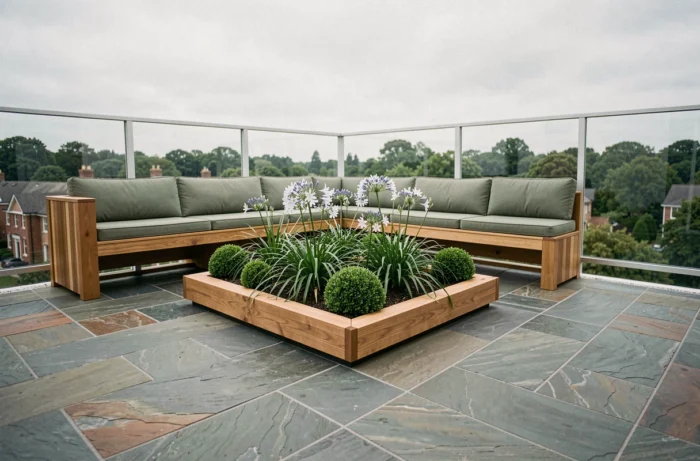
The choice of outdoor furniture and flooring (wooden terrace, paving, stabilized gravel) must remain consistent with the plant style. A rattan lounge in a country garden creates a mismatch. Conversely, a raw wood bench in a minimalist setting appears incongruous.
The decorative gardener offers a palette of materials that dialogues with the hues of the foliage and the color of the facade. This visual coherence is what distinguishes a professional layout from a collection of purchases from a garden center.
Annual landscape maintenance: protecting the investment over time
A garden delivered by a professional is not a finished product. It is a living project that evolves with the seasons. The first two years after planting are the most critical for the rooting of plants.
Regular monitoring allows for adjustments in watering, spotting the first signs of disease, and correcting growth imbalances. Some plants take up more space than expected, while others struggle to establish: the professional intervenes to rebalance the volumes.
This monitoring also includes specific seasonal tasks:
- Training pruning of young trees at the end of winter to shape their silhouette
- Dividing perennials every three to four years to maintain their vigor
- Organic mulching in spring to limit evaporation and nourish the soil
- Cleaning structures (pergola, trellis) before moss degrades the materials
It is also worth noting that burning green waste in the garden remains prohibited in 2026, a common practice that exposes one to penalties. The professional organizes the removal or composting of this waste in accordance with regulations.
Entrusting maintenance to the same professional who designed the garden ensures continuity. They know each plant, its rhythm, and its needs. The garden matures year after year, instead of slowly degrading due to a lack of proper care.