In France, burglaries of homes remain at a high level despite a downward trend observed since 2023 according to the Ministry of the Interior’s Statistical Service (SSMSI). Burglary attempts, on the other hand, remain numerous and largely underreported. This context raises questions about the measures that truly reduce risk, beyond the generic recommendations found everywhere.
Breach Time: The Threshold That Makes Burglars Give Up
Most security guides list equipment without explaining why they work. The deterrent mechanism is based on a principle documented by security professionals: a burglar generally gives up after more than three minutes of effort on an access point. Each additional obstacle extends this time and increases the likelihood that they will abandon the attempt.
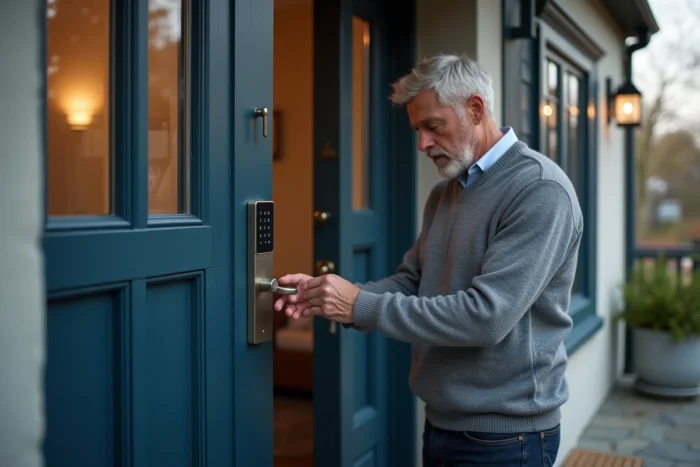
This means that the most effective strategy is not to pile on expensive devices, but to multiply physical barriers on the most vulnerable access points. A front door equipped with a certified multi-point lock, combined with a high-resistance cylinder and a cylinder guard, may be enough to exceed this threshold. For windows and patio doors, lockable handles or metal restrictors serve the same purpose of slowing down the intruder.
This reasoning based on breach time allows for prioritizing investments. It is possible to consult the Protect Habitation website to keep up with news on protection devices suitable for each housing configuration.
Visible Alarm and Burglary Risk: What French Data Says
A joint INSEE-ONDRP-SSMSI survey established that a home equipped with an alarm has a risk about three times lower than that of a non-equipped home. This is the most solid statistical data in France on the subject, and it is rarely cited in consumer guides.
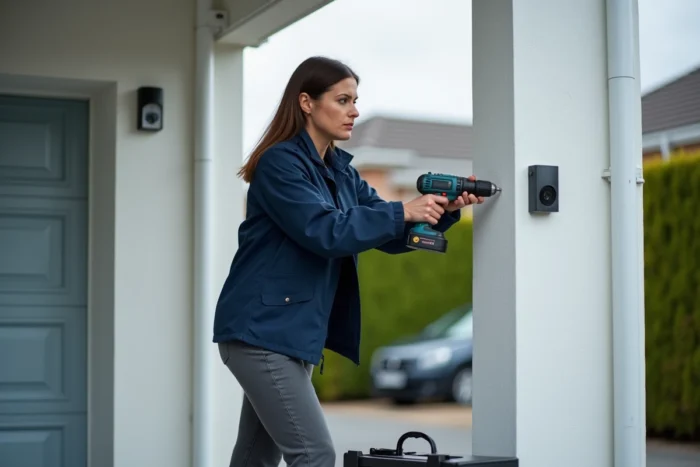
The word “visible” is as important as the word “alarm” in this equation. An alarm system whose presence is not indicated from the outside loses much of its deterrent effect. Warning signs, visible detectors on facades, and outdoor sirens contribute to what specialists call passive deterrence.
Wired or Wireless Alarm: A Choice Depending on the Structure
Wireless systems dominate the consumer market due to their ease of installation. However, in an old house with thick walls, the radio range between the sensors and the control panel can be problematic. Field reports vary on this point depending on the thickness of the partitions and the layout of the rooms.
For a new or recent home, a wireless kit with motion detectors and opening sensors covers most needs. For a stone building with multiple levels, a wired or hybrid system offers superior transmission reliability, at the cost of a more complex installation.
Network Vulnerabilities and Connected Objects: A Common Blind Spot
IP surveillance cameras, connected locks, and detectors linked to the home Wi-Fi create a digital entry point that few homeowners secure. A poorly protected Wi-Fi network can allow someone to disable a connected alarm remotely.
Basic precautions are rarely applied:
- Change the default password of the router and each connected object upon installation, using long and unique combinations.
- Create a dedicated Wi-Fi network for security devices, separate from the network used by home computers and smartphones.
- Update the firmware of cameras and the alarm control panel as soon as the manufacturer releases a security patch.
This digital dimension transforms home protection. An effective alarm system connected to a vulnerable network offers a false sense of security.

Presence Simulation and Outdoor Lighting: Real Effectiveness Against Intrusions
Presence simulation appears in all guides, but its effectiveness depends on the credibility of the device. A simple timer that turns on a living room lamp at a fixed time each evening does not fool a burglar for long who observes habits over several days.
Television light simulators (which replicate the color variations of a lit screen) add a layer of realism. Combined with random timers in different rooms, they complicate prior surveillance of the home. Random variation in lighting is more deterrent than a repetitive pattern.
Outdoor Lighting with Motion Detection
A spotlight triggered by a motion sensor above the front door, gate, or side access serves two simultaneous functions: it eliminates shadowy areas exploited to force entry, and it alerts occupants or neighbors to any approach.
For the device to remain effective, the sensor must be set to avoid false triggers (animals, branches). A poorly calibrated sensor eventually gets ignored by the neighborhood, nullifying the alert effect.
Tranquillité Vacances Device: A Free and Little-Known Surveillance
The “Tranquillité Vacances” device (formerly “Operation Tranquillité Vacances”) offered by the national police and gendarmerie allows you to report your absence to benefit from regular patrols in front of your home. Registration can be done online or directly at the police station or gendarmerie.
This free service remains underutilized. It does not replace an alarm system or physical protections, but it adds a layer of human surveillance during prolonged absences. In case of an anomaly detected during a patrol, law enforcement notifies the owner or the designated trusted person.
Protecting a home against intrusions relies on accumulating barriers rather than a single device. Combining physical obstacles that extend breach time, a visible alarm, a secured home network, and credible presence simulation covers the main exploited vulnerabilities. The Tranquillité Vacances device adds an additional resource, at no cost, that too few households activate before leaving.