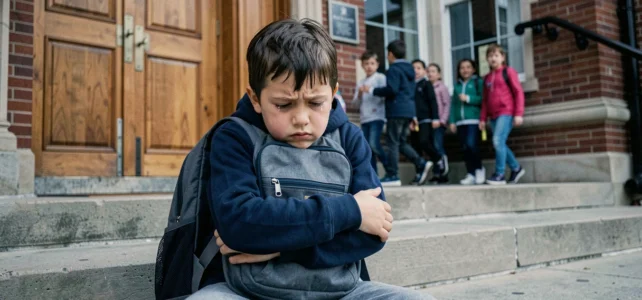
Didaskaleinophobia refers to an intense and persistent fear of school, distinct from mere whim or temporary laziness. This disorder, also known as school refusal anxiety, affects a significant portion of school-aged children and causes distress that far exceeds the scope of difficult mornings. Stomachaches, panic attacks, and a physical inability to cross the school’s threshold: the manifestations are varied and often bewildering for families.
School refusal anxiety and silent dropout: two faces of the fear of school
The most well-known form of didaskaleinophobia is dramatic: crying, vomiting, and a categorical refusal to leave the house. Parents quickly notice that something is wrong. In contrast, another, more discreet form often escapes adult vigilance.
Since the periods of lockdown and prolonged school disengagement related to Covid, educational resources have reported an increase in silent school dropout: intermittent absenteeism, decreased class participation, gradual social withdrawal, chronic fatigue. These subtle signals can represent milder forms of school phobia.
The risk is real: without intervention, this silent dropout can evolve into a more pronounced school refusal. Educational teams are now encouraged to systematically monitor these indicators, particularly during reintegration after prolonged absences. To understand didaskaleinophobia in children, it is essential to look beyond visible crises and pay attention to these gradual withdrawals.
Didaskaleinophobia: the anxiety mechanisms behind the fear of school
School phobia is not limited to a single trigger. It often fits into a broader anxious picture, where several factors combine.
Internal factors related to the child
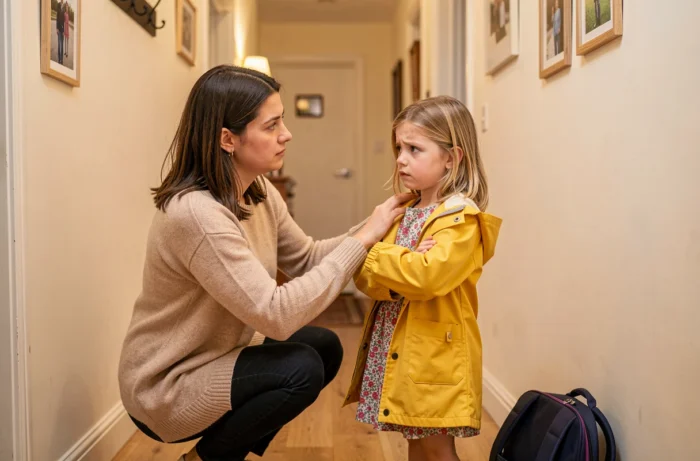
- Separation anxiety, common among younger children, makes the distance from the parent unbearable. The child’s brain then associates school with a direct threat to their attachment bond.
- The fear of failure or judgment from peers generates chronic stress. Some children develop such strong anticipatory anxiety that the mere prospect of an evaluation triggers physical symptoms (abdominal pain, nausea, headaches).
- Neurodevelopmental disorders (hyperactivity, learning disabilities) can amplify feelings of mismatch and fuel daily school anxiety.
Factors related to the school environment
Bullying remains a major trigger. Academic pressure, a classroom climate perceived as hostile, or a change of school can also be sufficient to establish phobia. Field reports vary on the respective contribution of each factor, as each child experiences a unique combination of causes.
One point deserves attention: school phobia is often linked to pre-existing anxiety or depressive disorders. It does not appear out of nowhere. Identifying an anxious background in the child before the situation crystallizes around school remains the best preventive measure.
Progressive reschooling: why distance learning is no longer the reflex response
For several years, school disengagement followed by recourse to CNED or distance learning has been a common response to school refusal anxiety. This approach is now being questioned.
Support resources published since the mid-2020s emphasize a paradigm shift: progressive reschooling within the institution is now the priority. Distance learning should only be a temporary measure when the student is completely disengaged, and always within a structured framework.
In practice, this involves an individualized project. The child returns to school in stages: a few hours per week, in a designated space, with very gradual attendance times. The goal is to retrain the child’s nervous system to the school environment without overwhelming them.
This approach is based on a principle documented in cognitive-behavioral therapy: avoidance reinforces phobia. The longer a child stays away from school, the more anxiety-provoking the return becomes. Conversely, gradual and secure exposure helps reduce the fear response.
Supporting a child with school phobia: the role of parents and the educational team
Supporting a child affected by didaskaleinophobia never relies on a single person. It requires coordination between the family, the school, and health professionals.
For parents, the first challenge is distinguishing phobia from a whim. A child who fakes a stomachache to stay home and a child whose body produces real pain related to anxiety do not need the same response. The physical symptoms of school refusal anxiety are real, not feigned. Denying this worsens the situation.
The school, for its part, plays a central role. Possible adaptations are numerous:
- Adjustment of a lighter schedule with designated rest periods within the institution.
- Appointment of a reference adult (teacher, school counselor, school nurse) to whom the child can turn in case of a crisis.
- Regular communication between the educational team and the therapist following the child, to adjust the pace of reschooling.
- Increased vigilance regarding bullying and the classroom climate, prior to any attempts at reintegration.
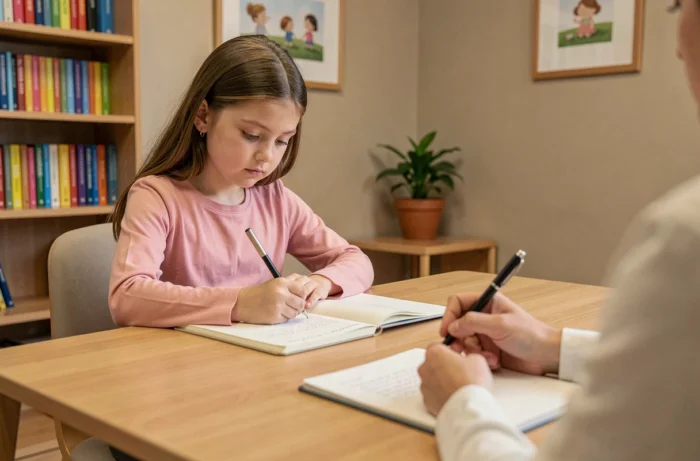
Psychological support is generally recommended. Cognitive-behavioral therapy is the most documented for this type of anxiety disorder. It works on catastrophic thoughts, avoidance behaviors, and physiological responses related to fear.
The available data do not allow for a conclusion on a single protocol that would work for all children. What emerges from field reports is the necessity of a early, comprehensive, and collaborative approach: the earlier the intervention, the lower the risk of prolonged disengagement.
Didaskaleinophobia leaves traces beyond schooling. Isolation, loss of confidence, relational difficulties: the long-term documented consequences remind us that this disorder deserves as much attention as a physical illness. Treating the fear of school also means protecting the child’s social and professional trajectory.