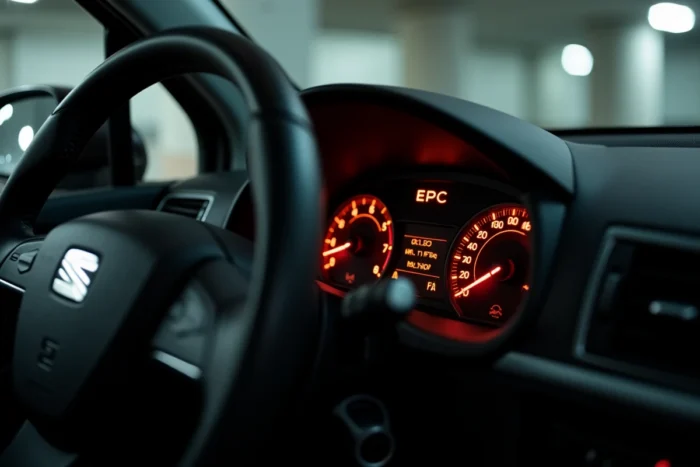
The EPC (Electronic Power Control) warning light on Seat Ibiza or Volkswagen Polo indicates a fault in the electronic management chain of the gasoline engine. This orange light is not just a maintenance reminder: it signifies an anomaly detected by the ECU in a specific component of the intake, ignition, or throttle management circuit.
Electrical harness and faulty connections: the lead that standard diagnostics miss
We regularly observe cases in the workshop where the OBD2 diagnostic points to a fault code on the throttle body or pedal sensor, while the part itself is functioning. The problem lies with the harness that powers it.
On Ibiza and Polo models, the harnesses pass through areas exposed to moisture and vibrations. Wires chewed by rodents trigger intermittent EPC alerts that simple code reading cannot identify. The connector of the throttle body, located under the intake manifold, is particularly vulnerable to oxidation.
A faulty connection produces an erratic signal that the ECU interprets as a clear failure. The vehicle enters limp mode, the EPC light comes on, and then everything returns to normal upon restarting. This cycle can repeat for weeks before an in-depth diagnosis locates the damaged section of the harness.
We recommend systematically checking the condition of the connectors and the continuity of the harness before replacing a throttle pedal sensor or throttle body. An issue with an EPC warning light on Seat Ibiza or Polo can sometimes be resolved with a connector cleaning and heat-shrink tubing, without needing a new part.
Throttle body and accelerator sensor: distinguishing the symptoms
The motorized throttle body and the accelerator pedal position sensor are the two components most often implicated. Their symptoms are similar, but the failure logic differs.
A clogged or faulty throttle body causes stuttering at idle, unstable RPMs, and sometimes engine stalling. The ECU detects a discrepancy between the commanded position and the actual position of the flap, and turns on the EPC light.
A defective pedal sensor generates an inconsistent signal between the two potentiometric tracks. The ECU receives two contradictory values and cuts off the throttle response for safety. The car no longer responds to the pedal being pressed, or only partially.
- Throttle body: unstable idle, stalling, slight progressive power loss. Cleaning with a specific product (not WD-40) resolves the issue in the majority of cases
- Pedal sensor: abrupt loss of acceleration, inability to exceed a certain RPM, erratic behavior from one trip to another
- Turbo actuator (on TSI engines): power loss above certain RPMs, abnormal whistling, fault codes related to boost pressure
Cleaning the throttle body requires a recalibration via diagnostic tool on these engines. Disconnecting the battery is not enough to reset the learned values of the ECU. Without this procedure, the idle remains unstable even after perfect cleaning.
EPC combined with the engine light and stop-start: analyzing the complete system
On recent Ibizas, the EPC light sometimes appears simultaneously with the engine light and an error message related to the stop-start system. This combination indicates that the ECU has switched to global limp mode, not just on acceleration management.
The limp mode limits engine power to protect the catalytic converter and transmission. The stop-start feature is automatically disabled, as the ECU can no longer guarantee a reliable restart with an out-of-tolerance engine parameter.
We frequently observe this scenario after an intervention on the exhaust or when the catalytic converter is faulty. A degraded catalytic converter alters the values of the lambda sensors, which the ECU interprets as a combustion fault. The EPC light comes on as a cascading effect, not because the acceleration system is at fault.
Reading the fault codes via an OBD2 tool remains the starting point, but it is not sufficient. It is necessary to cross-reference the codes with real-time data (lambda sensor values, boost pressure, throttle position) to identify the root cause.
OBD2 diagnostics on Polo and Ibiza: beyond code reading
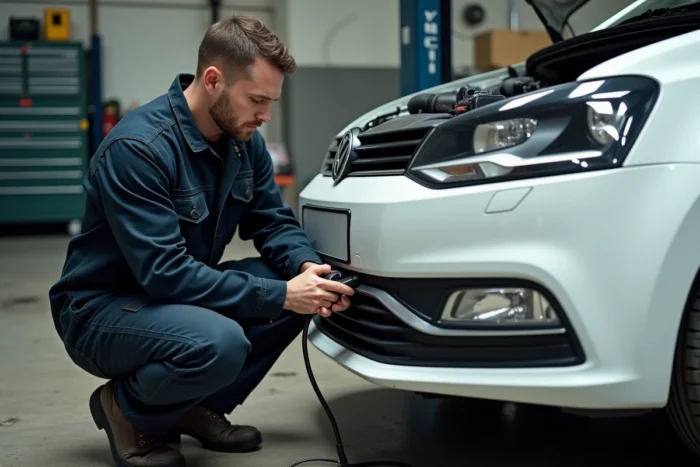
An entry-level OBD2 reader displays the fault code stored in the engine ECU. On a Polo or Ibiza, the most common codes associated with the EPC light concern the throttle circuit, the pedal sensor, and the ignition circuit (spark plugs, coils).
- Throttle-related codes: position discrepancy, control circuit, adaptation out of limits
- Pedal sensor-related codes: out-of-range signal, inconsistency between tracks, open circuit
- Ignition-related codes: combustion misfire detected on one or more cylinders, often associated with worn spark plugs or faulty pencil coils
- Turbo-related codes (TSI): insufficient boost pressure, wastegate actuator
A single fault code does not always indicate the part to be replaced. A “pedal sensor out of range” code can originate from the sensor, the connector, the harness, or the ECU itself. Substitution diagnosis remains the most reliable method to distinguish between these hypotheses.
VAG-compatible tools (the proprietary protocol of the Volkswagen group) provide access to advanced functions that the generic OBD2 protocol does not offer: throttle adaptation, actuator testing, reading measurement blocks. On these vehicles, a generic tool limits the depth of analysis.

Driving with the EPC light on
Limp mode protects the engine, but it is not designed for prolonged use. The power limitation prevents normal RPM increases, which puts more strain on the clutch and transmission during acceleration phases.
On TSI engines equipped with a DSG transmission, limp mode can cause harsh gear shifts. The transmission ECU receives inconsistent torque information, which ultimately generates additional fault codes in the mechatronic unit.
An EPC light that comes on intermittently and then disappears is not trivial. The fault is stored in the ECU’s memory even if the light goes out. Ignoring these intermittent alerts turns a simple repair (connector, spark plug, cleaning) into a heavy intervention on the complete throttle body or engine ECU.