
The wedding format in France has shifted. Micro-weddings and weekend weddings are no longer marginal options; they now account for the majority of requests handled by wedding planners. Organizing a wedding in 2026 requires thinking in terms of a sequence of moments (arrival on Friday, ceremony on Saturday, brunch on Sunday) rather than a single day. This change in format profoundly alters the management of vendors, the reception venue, and the budget.
Weekend wedding: structuring three days without tripling the budget
A wedding spread over an entire weekend necessitates securing on-site or nearby accommodation. We recommend negotiating a group rate with the venue or nearby gîtes as soon as the rental contract for the venue is signed. The accommodation cost, often absent from traditional budgets, becomes the second largest expense after catering.
The budget logic also changes regarding catering. The Friday night dinner and Sunday brunch do not require the same level of service as the ceremony meal. Planning for a single caterer for all three meal times helps smooth costs and simplify logistical coordination.
On lemondedumariage.fr, vendor sheets allow filtering by accommodation capacity and weekend packages, which speeds up the pre-selection of venues compatible with this format.
The weekend wedding reallocates the budget towards accommodation and catering outside the ceremony. Ignoring these items from the initial budgeting guarantees a budget overrun at the end of preparations.
Micro-wedding in France: guest list and choice of reception venue
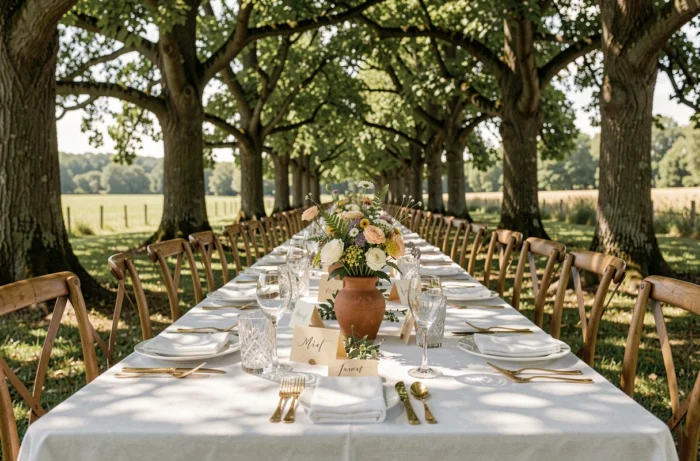
The micro-wedding (fewer than fifty guests) has become the norm in 2026, not a Plan B. This format radically changes the specifications for the reception venue. Large estates with ballrooms are no longer suitable; smaller, often private properties, privatized fine dining restaurants, or agricultural farms are needed.
The small guest list is not built by subtraction. We observe that couples who start with a large list and remove names end up frustrated. The reverse approach works better: start from scratch, listing only the people whose absence would make the day incomplete.
- Check the minimum capacity required by the venue (some estates impose a minimum number of guests for privatization)
- Adapt the seating plan to a unique format: a single large table in a U-shape or rectangle enhances intimacy
- Plan for a higher vendor-to-guest ratio, as a micro-wedding requires the same logistical coordination as a large wedding with less margin for error
Civil ceremony and administrative procedures: what concretely blocks
The civil ceremony has no legal value in France. The passage to the town hall remains the only union recognized by law. This point, often mentioned in a single line in guides, generates concrete scheduling blockages.
The town halls of rural municipalities popular for outdoor weddings have very limited slots, sometimes only one Saturday per month during the summer. Booking the reception venue before confirming the town hall slot risks a date shift. Confirming the town hall slot before any other reservation remains the most reliable sequence.
On the document side, the civil marriage file requires documents with varying processing times. The birth certificate of less than three months, for example, must be requested online from the town hall of birth, and some municipalities take several weeks to respond. Initiating this request as soon as the date is set avoids unnecessary stress two months before the big day.

Decoration trends and wedding color palette 2026
Color palettes now dictate the choice of floral vendors, stationery, and table scenography. In 2026, trends lean towards earthy tones and unusual combinations, far from the powdery blush that dominated previous years.
The chromatic coherence between invitations, floral decoration, and lighting distinguishes a scenographed wedding from a simply decorated one. A good florist works from a moodboard approved by the couple, not from a list of flowers.
The choice of bride’s accessories follows the same logic. Retro accessories (fascinators, short gloves, corsage pins) are making a strong comeback in the 2026 collections. They are no longer vintage whims but elements integrated into the silhouettes offered by designers.
Selection of wedding vendors: prioritizing reservations
Not all vendors have the same reservation timeline. The sequence we recommend follows a logic of technical dependency, not personal preference:
- The reception venue is booked first as it determines the date, capacity, and technical constraints (sound system, mandatory or free caterer, curfew)
- The caterer comes second, especially if the venue does not impose one: good event caterers are fully booked a year in advance for the May-September season
- The photographer and videographer are then scheduled, as their availability depends on the date, not the venue
- The officiant for the civil ceremony, the DJ, and the florist are reserved in a third phase, with a wider margin for maneuver
Contact five vendors per category simultaneously, compare quotes on identical bases (same number of guests, same duration of service), and sign contracts with a deposit within a week after validation. Beyond that, the slot may be lost.
The timeline for a wedding in 2026 no longer follows the linear logic of traditional guides. The weekend format, micro-wedding, and pressure on town hall slots require handling topics in parallel that older schedules addressed sequentially. Starting with the town hall slot and the venue, securing complete catering, and then refining the scenography: this method remains the most robust for a well-managed wedding.