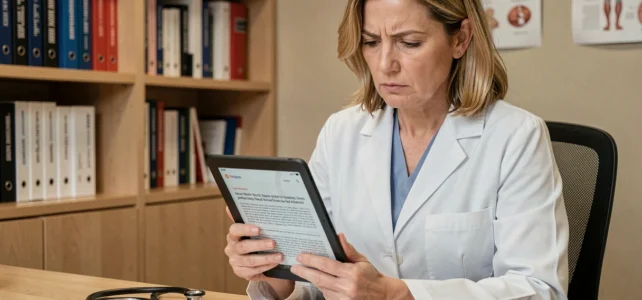
We receive a message on a group messaging platform: a miracle food against cancer, a warning against a common medication, a video from a supposed doctor contradicting official recommendations. Even before verifying anything, the content has already been shared a dozen times. It is in this very concrete situation that the ability to decipher health information and sort reliable medical information from the rest comes into play.
Health Misinformation: What Recognition as a Specific Risk Changes
The French authorities no longer treat health misinformation as a mere sub-genre of fake news. A Senate information report now identifies health misinformation as a distinct risk category within the framework of the European Digital Services Act (DSA). The idea is to grade risk levels by theme and to consider health as a priority area.
In practical terms, this means that platforms may be required to more strictly moderate health content compared to other categories of information. For us, the users, this is a signal: online health content is subject to increasing regulatory oversight, but this oversight does not replace our own vigilance.
At the same time, France is working on a national strategy structured around several pillars: education, improvement of public information, and the establishment of an infovigilance system modeled after pharmacovigilance. This system includes the creation of an observatory for health misinformation, responsible for monitoring, analysis, and alerts. You can consult the skepticnorth.com health site to cross-reference these approaches with critical English-language analyses on the same topics.

Health Fake News: Spotting Warning Signals in Online Content
Rather than listing generic advice, let’s start with a common case: an article shared on social media claims that a virus was created in a laboratory, citing “a recent study.” We click, and we land on a site with no legal notice, no identified author, featuring ads for dietary supplements.
The absence of an identifiable author is the first warning signal. Reliable medical content cites its sources, names the professionals or institutions behind the data, and links to verifiable publications. When an official source is mentioned in a text, it is essential to check directly on that institution’s site to see if the information is actually there. Some misinformation claims to come from recognized organizations that have never published the information in question.
Here are the elements to systematically verify before sharing health content:
- Is the issuer a public organization, an identified healthcare professional, or a recognized scientific journal, or is it an anonymous source, a forum, or a commercial site?
- Does the content cite specific studies with consultable references, or does it rely on vague phrases like “researchers have shown”?
- Is the information reported by multiple independent trusted sources, or does it circulate only in closed circles?
- Is the tone sensationalist (“miracle,” “what they are hiding from you,” “revelation”) or factual and nuanced?
These checks take a few minutes. They are enough to eliminate the majority of misleading content.
Conversational AI and Medical Information: A New Blind Spot
We are increasingly asking our health questions to conversational AIs rather than a traditional search engine. The response comes in the form of fluid, structured, reassuring text. The problem: an AI can formulate a false answer with the same assurance as a correct one.
Conversational AIs do not verify their sources as a healthcare professional would. They generate statistically probable text, not necessarily accurate. When asked about complex medical topics (drug interactions, rare symptoms, treatment protocols), the reliability of the responses varies.
The reflex to adopt: consider an AI’s response as a starting point, never as a diagnosis or medical advice. Cross-reference systematically with institutional sites (Ministry of Health, HAS, Inserm) or consult a healthcare professional remains the only reliable approach.

Influencer Doctors on Social Media: Between Popularization and Promotion
Healthcare professionals are building massive audiences on social media. Their white coat and doctor title serve as a guarantee of credibility. The line between useful popularization and commercial promotion sometimes becomes blurred.
Some influencer doctors recommend products, supplements, or aesthetic procedures linked to commercial partnerships. The content resembles medical information, but it is advertising. In France, advertising for medical acts is regulated by the code of ethics, but social media complicates the application of these rules.
A healthcare professional who sells a product in the same video where they make a diagnosis is no longer acting as a caregiver. We can continue to follow these accounts for their educational content, as long as we clearly distinguish the moments when they are informing from those when they are selling.
Three Questions to Ask When Facing Content from an Influencer Doctor
Does the professional cite published data or rely solely on their personal experience? Does the content mention a partnership or a commercial link? Would the recommendations made be the same in a traditional consultation, without a camera?
These filters do not automatically disqualify the content. They help place it in its real context: that of a social network where visibility depends on engagement, not scientific rigor.
Deciphering health online does not require becoming a medical expert. Tracing back to the source, verifying the issuer, and cross-referencing with institutional sites covers the vast majority of situations. The health misinformation observatory, once operational, will provide an additional tool. In the meantime, the most effective filter remains the one we apply ourselves before clicking “share”.