In high school, the idea of getting into a design school can quickly become overwhelming. You start comparing programs, piling up extracurricular activities, and wanting a perfect portfolio even before your final year. The result: a disproportionate mental load compared to what is actually expected. The good news is that most design programs do not require a superhuman profile. A few well-chosen regular habits are enough to build a solid application.
Real selectivity of design programs: what the admission rates say
Before diving into intensive preparation, it’s worth looking at the admission figures. Many high school students overestimate the difficulty of getting into public design programs.
The DN MADE Object at Lycée La Tourrache, for example, boasts a 90% admission rate. The last admitted student was ranked 77th for 20 spots, and most students came from a general baccalaureate. This is not an isolated case: several DN MADE programs in France remain accessible without an extraordinary application.
That doesn’t mean there’s nothing to prepare. Selective private schools and some highly sought-after MANAA programs maintain tighter admission rates. The key is to target programs that match your level and interests, rather than just aiming for the most prestigious ones and exhausting yourself.
When you want to prepare for a design school as early as high school, the first useful reflex is to check the Parcoursup sheets of the targeted programs to verify their actual selectivity.
High school specialties and design: the choices that really matter
Are you torn between visual arts, digital, math? This question comes up every year in the second year. And the answer is less clear-cut than one might think.
The visual arts specialty, an asset but not a requirement
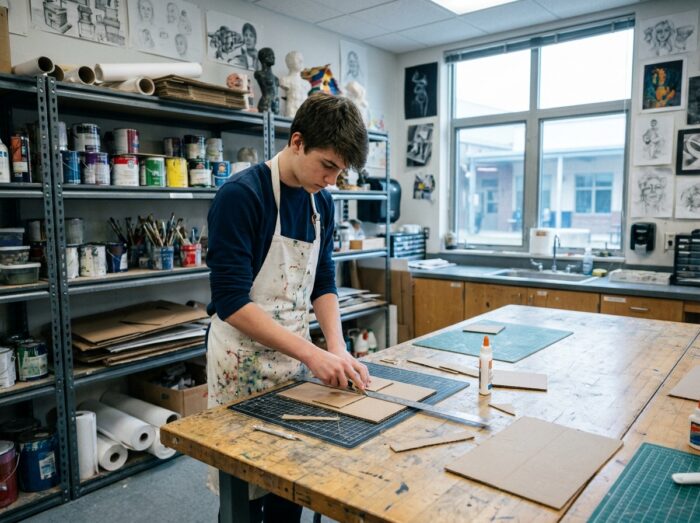
Choosing visual arts in the first and final years sends a clear signal to the juries. You develop visual culture, learn to articulate your artistic choices, and get used to critique. For a DN MADE application or a private school, this is a concrete advantage.
However, design juries do not reject a candidate because they chose SVT or NSI. Teachers at these schools repeat it: what matters is curiosity and the ability to formulate a personal project. A student with a scientific profile who regularly draws and shows an original perspective has as much chance as a 100% artistic profile.
The STD2A baccalaureate, a dedicated path but not the only one
The STD2A baccalaureate (sciences and technologies of design and applied arts) remains the most directly connected pathway to design professions. Students practice drawing, modeling, and analyzing objects and spaces from the second year.
But this pathway is only offered in a limited number of high schools in France. If no STD2A institution is geographically accessible, a general baccalaureate with a visual arts specialty and regular personal work is a perfectly valid alternative.
Building a portfolio in high school without creating a second job
The portfolio is the central piece of any application to a design school. It is also the main source of stress for high school students. How many pages? What level of finish? Are digital projects necessary?
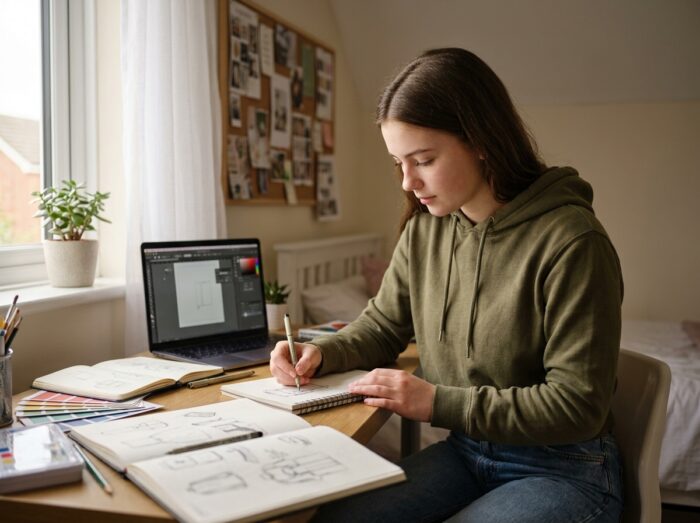
A good portfolio shows a process, not a collection of perfect drawings. The juries want to understand how you think, not to evaluate your pure technique. A regular sketchbook, even imperfect, is often more valuable than a series of highly polished boards created in a rush.
Here’s what a high school portfolio can contain without the preparation becoming a burden:
- Sketchbook pages: everyday objects, spaces, people observed in transport or in the city. Ten minutes a day is enough to fill a sketchbook in a few months.
- One or two completed personal projects: a poster, a redesigned object, a conceptual space layout. What matters is showing the process (research, trials, final choice).
- Commented visual references: photos from exhibitions, captures of projects by designers who inspire you, with a few lines explaining why.
- Free experiments: collages, cardboard models, typographic tests. The jury wants to see curiosity, not perfection.
Working on your portfolio for fifteen to twenty minutes a day instead of eight hours on the weekend before the deadline changes the quality of the result and preserves energy.
Visual culture and orientation: what can be prepared without extra effort
Certain habits develop a culture in design without adding to the workload. They integrate into daily life and nourish both the portfolio and the motivation interview.
Visiting a design or architecture exhibition once a quarter provides concrete material for an interview. There’s no need to aim for the big Parisian museums: media libraries, local galleries, and heritage days offer regular opportunities.
Following a few designers or studios on social media allows you to familiarize yourself with trends, tools, and the vocabulary of the profession. It’s passive, free, and develops a critical eye without conscious effort.
The Education Code provides that information on orientation is organized each year in high schools. In practice, this means that institutional times exist to ask questions about design programs, career prospects, and access pathways. Taking advantage of these avoids having to search for everything alone outside of classes.
The motivation interview, an exercise that is prepared by living
The juries ask simple questions: why design, which projects have impacted you, what object or space would you like to improve? The most convincing answers come from candidates who have observed their environment attentively, not from those who have memorized formulas.
Keeping a written record (even brief) of objects, places, or visuals that catch your attention throughout the year constitutes valuable material for the day of the interview.
Preparing for a design school in high school requires neither artistic perfection nor an overloaded schedule. Regularity, curiosity, and a portfolio that reflects personal thought form the foundation that juries are looking for. It’s better to have a sketchbook filled over the months than a spectacular application put together in a panic in January.