The Balagne and Cap Corse have dozens of coves where underwater visibility exceeds what is found at the overcrowded spots in the south. With shallow rocky bottoms and moderate traffic, the northern part of the island offers a snorkeling terrain that deserves attention.
The water remains clear even in the height of summer, including at sites accessible without a boat, making it an underrated snorkeling area.
Blue Crab in Corsica: What It Means for Snorkeling
Before discussing spots, there is a topic that directly concerns snorkeling. The IRD (Institut de Recherche pour le Développement) has confirmed the arrival of the blue crab (Callinectes sapidus) in Corsica, an invasive species from the American Atlantic coasts. This crustacean, already problematic in several Mediterranean lagoons, is colonizing shallow areas, exactly where snorkeling takes place.
Its claws are powerful and can injure a foot or hand placed in the wrong spot. In practical terms, it is advisable to avoid standing on sandy bottoms in the transition zones between seagrass meadows and rocks. Water shoes are no longer just a comfort accessory, but a useful protection.
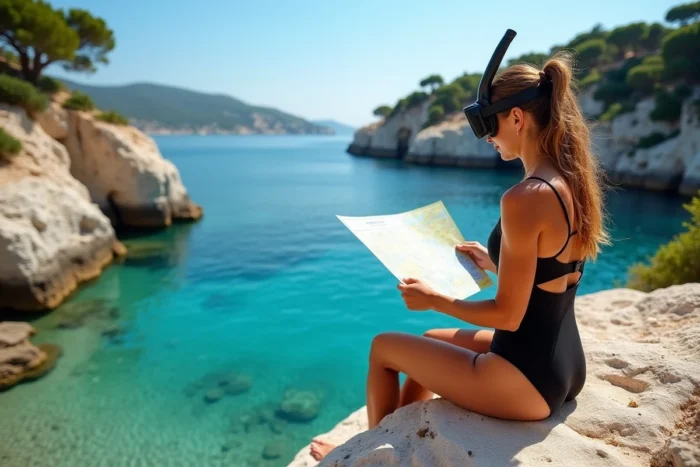
The other consequence is ecological. The blue crab preys on local species (small crustaceans, shellfish) that snorkelers usually observe. In some areas, changes in visible fauna are already noticeable. To identify the affected sectors and plan outings with full knowledge, one can rely on a map of northern Corsica for snorkeling that locates the entry points.
Snorkeling Spots in Balagne: Calvi, Île-Rousse and Surroundings
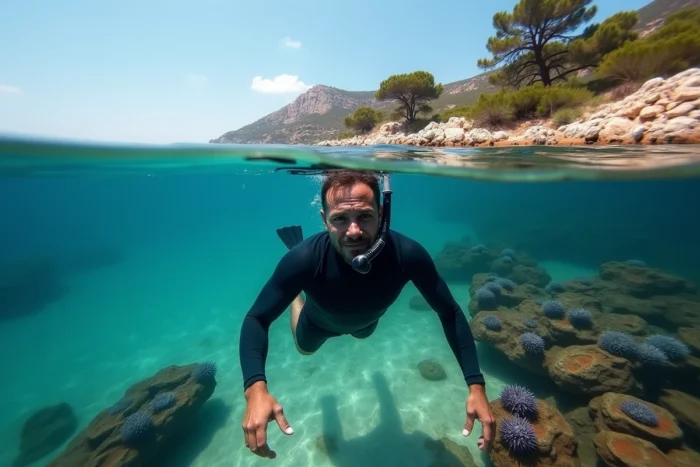
Balagne concentrates the most accessible spots in the north. In Calvi, the entry from the large sandy beach is easy, even with children. One can walk along the successive jetties where juveniles gather: breams, mullets, damselfish, wrasses. The jetties of Calvi host a natural nursery of Mediterranean fish.
For a wilder setting, Bodri Beach (between Île-Rousse and Calvi) offers a mixed sandy and rocky bottom with shallow water extending for several dozen meters. Access is via a path from the road, which limits traffic. Schools of mullets and octopuses are often seen among the rocky blocks.
Around Île-Rousse
On the Île-Rousse side, the small coves accessible on foot from the town center allow for short but rich sessions. The rocks at the foot of the peninsula offer remarkable visibility in the morning, before the wind picks up. An early outing is preferred to avoid the afternoon swell that stirs up the sand.
Cap Corse and the Agriates Desert: Snorkeling in a Preserved Area
Cap Corse remains the least frequented area for snorkeling, while its rocky bottoms are among the richest in the north. The coves on the west side (between Centuri and Nonza) combine shallow depth, volcanic rock, and an almost total absence of pleasure boats.
The Agriates Desert, on the other hand, is home to beaches accessible only by track or boat. Saleccia Beach, often cited for its terrestrial beauty, also hides interesting bottoms along its rocky ends. It is advisable to avoid the central area (uniform sandy bottom, little life) to follow the rocky points where fish and sea urchins concentrate.
Precautions Related to Isolation
These remote spots impose some constraints:
- No lifeguard station or reliable mobile network in most coves of Cap Corse and Agriates. One should inform someone of their itinerary and expected return time.
- The water can be significantly cooler on the west side of the cape at the beginning of the season (Ligurian currents). A short neoprene top is usually enough to extend the session.
- The west wind (libeccio) quickly raises a swell that reduces visibility to a few meters. One should check the marine weather the day before and prefer calm mornings.
Brown Grouper and Ethical Observation in Snorkeling
The north of Corsica is one of the areas where the brown grouper has returned after decades of strict protection. While snorkeling, one can encounter individuals in the deep rocky areas of a few meters, particularly around Cap Corse.
The regulations are very strict: any form of harvesting of the brown grouper is prohibited, and harassment behaviors (pursuit, attempts to touch) are punishable. In practice, one should maintain a distance of a few meters, avoid sudden movements, and not feed any species. A grouper accustomed to human presence will stay in place if not frightened.
This encounter is one of the highlights of snorkeling in northern Corsica. It is not guaranteed (returns vary on this point depending on the season and site), but the deep rocky areas of Cap Corse offer the best probabilities.
Equipment and Conditions for Snorkeling in Northern Corsica
The basic equipment remains classic: fins, mask, and snorkel. Some specific adjustments for the north deserve attention.
- Water shoes with rigid soles, essential on the rocky entry points of Cap Corse and as protection against the blue crab on sandy bottoms.
- Thin neoprene top for outings before the end of June or on the west side, where water temperature can be surprising.
- Buoyancy vest for children or beginners, especially in unmonitored coves.
- Small net or waterproof bag to carry out waste, as these sites do not have trash cans.
The best period extends from June to September. In June, traffic remains low but the water has not yet reached its summer temperature. July and August offer the best thermal conditions, with visibility that can exceed several meters at wind-sheltered spots.
Preserved bottoms, recovering fauna, and still moderate traffic: northern Corsica meets the conditions for quality snorkeling sessions, provided one respects access constraints and the fragility of the environments.