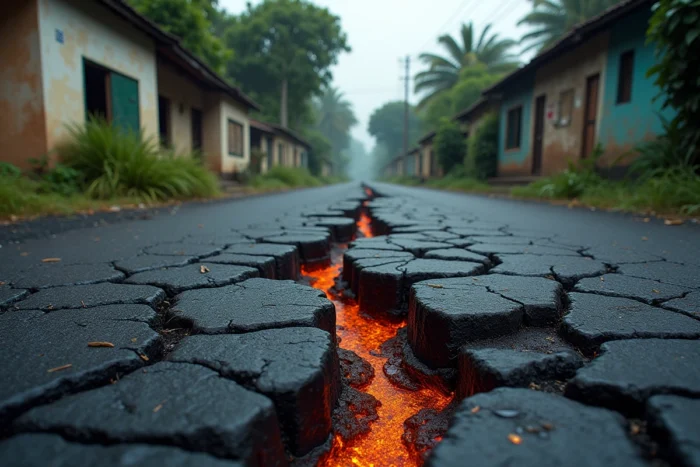
On May 22, 2021, the Nyiragongo volcano erupted about ten kilometers north of Goma, the capital of North Kivu, in eastern Democratic Republic of Congo. The lava flow spilled northeast of the city, destroying entire villages before stopping a few hundred meters from the airport and downtown.
According to official reports relayed by the Red Cross of the DRC, approximately 2,400 residential buildings were destroyed and at least 32 deaths were reported in the early hours.
Volcanic Monitoring and Failures of the Goma Observatory
The Goma Volcanological Observatory (OVG) is the only structure responsible for monitoring Nyiragongo’s activity. At the time of the eruption, its seismic and geodetic equipment had serious technical deficiencies, documented for several years by various scientific actors.
These shortcomings made it impossible to transmit real-time data. The precursory signals that could have triggered an early evacuation were either not detected or could not be communicated to local authorities.
A technical audit of the observatory had been requested multiple times, but never materialized. The monitoring of one of the most active volcanoes on the African continent thus relied on an infrastructure weakened by chronic underfunding. To better understand the volcanic eruption of Nyiragongo in Goma, one must measure the extent of this institutional failure: without reliable data, neither the authorities nor humanitarian workers could anticipate anything.
Timeline of the Crisis and Evacuations in Goma
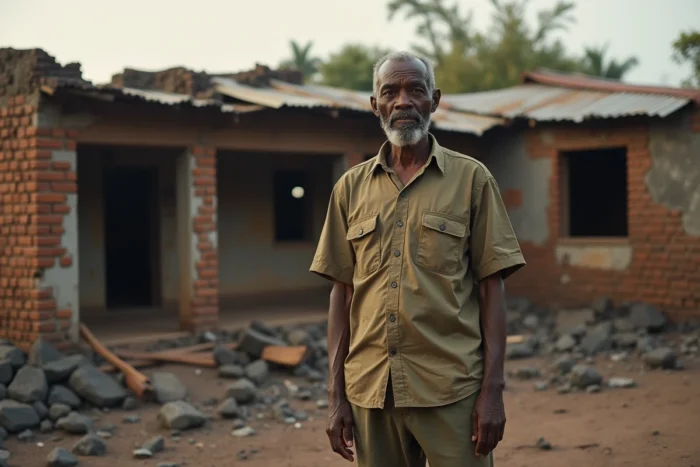
The lava began to flow down the southern flank of the volcano late in the day on Saturday, May 22. By nightfall, nearly 30,000 people had fled to Sake, 27 km to the west, or to neighboring Rwanda. Among the neighborhoods and villages directly affected by the flows were: Buhene, Mutowo, Bushara, Bunyuzu, Kabingo, and several other localities.
The following days were marked by intense seismic activity. Some earthquakes reached a magnitude of 5.1. Cracks appeared in several neighborhoods of Goma, including Majengo, Mabanga North and South, Bujovu, Virunga, and Murara.
On Thursday, May 27, the Congolese government announced that seismic data indicated the presence of magma beneath the urban area of Goma. A massive evacuation order was triggered. In total, approximately 450,000 people were evacuated in the days that followed.
Chaotic Communication from Authorities
Official evacuation instructions took time to reach the population. In this void, social media and word of mouth became the main channels of information, bringing with them rumors and misinformation.
Residents remembered the eruption of January 2002, when flows had engulfed part of Goma. The absence of coordinated crisis communication amplified the panic, in a context already marked by deep distrust of institutions.
Humanitarian Impacts and Ongoing Precarity in North Kivu
Two months after the eruption, most of the displaced had returned to Goma or its surroundings. The conditions for return remained precarious. Thousands of families were living in improvised sites or with relatives. The lava had devastated agricultural fields, depriving entire communities of their livelihoods.
- Several schools were destroyed, leaving teachers without income and children without access to education. Organizations like the Jesuit Refugee Service intervened in the areas of Mujoga and Mugerwa.
- The drinking water network was cut off, exposing the population to cholera in a region already weakened by recurring epidemics.
- Mass displacements exacerbated land tensions and local conflicts in host areas like Sake, Minova, and Rutshuru.
The Congolese institutional response remained limited in the face of the scale of needs. International organizations carried the bulk of the humanitarian effort.
Sexual Violence and Prolonged Security Crisis
The 2021 eruption cannot be isolated from the security context of North Kivu. Mass displacements created conditions conducive to increased violence, particularly against women and girls.
Doctors Without Borders reports that between January and April 2025, more than 7,400 survivors of sexual violence were treated in health facilities supported by MSF in Goma. This figure reflects a dynamic of chronic crisis where the memory of the eruption, the instability that followed, and the persistence of armed conflicts overlap, permanently altering the life trajectories of displaced or returning populations.
Nyiragongo and Goma: A Persistent Volcanic Risk
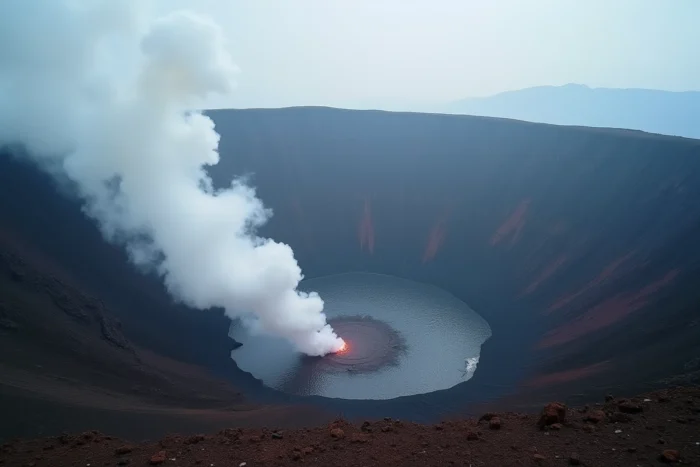
Nyiragongo remains one of the most dangerous volcanoes in the world. Its permanent lava lake and the exceptional fluidity of its flows pose a direct threat to Goma, a dense city that extends at the foot of the volcano, on the shores of Lake Kivu.
The available data do not allow us to determine whether the monitoring capabilities of the OVG have been significantly strengthened since 2021. Field reports vary on this point: some humanitarian actors mention occasional improvements, while others highlight the persistence of structural gaps in the funding and equipment of the observatory.
The coexistence of an active volcano, a rapidly expanding city, and a chronic armed conflict creates a situation where each new crisis amplifies the effects of the previous one. The eruption of May 2021 reminded the residents of Goma of this reality, which they had not forgotten since 2002. The subsequent events in the region have only confirmed it.