
The bodysuit is a one-piece garment that connects the bust to the hips through a continuous textile structure. This construction gives it a mechanical advantage over two-piece sets: the fabric stays in place, does not ride up, and maintains a smooth line from the neckline to the hips. Choosing a bodysuit that suits one’s silhouette depends on three specific technical parameters: the bust structure, the type of cut at the hips, and the fabric composition.
Bust tension and support: underwires, cups, and triangles
The support of the bust in a bodysuit depends on the system integrated at the chest level. Three construction families coexist, each addressing a different need.
Underwired bodysuits offer structural support. The metal or plastic underwire conforms to the underside of the breast and redistributes the weight towards the underbust band. This system is suitable for generous busts that require support comparable to that of a classic bra.
Preformed cup bodysuits, sometimes associated with a push-up effect, add volume and round out the shape. Their relative stiffness makes them less suitable for prolonged wear, but more effective for a defined silhouette under fitted clothing.
Triangle models, without underwire or cups, focus on flexibility. The fabric wraps around the bust without constraining it. A stretch lace triangle is suitable for smaller busts and for situations where comfort takes precedence over support. For larger busts, checking for a wide elastic band under the bust partially compensates for the absence of underwire.
Several specialized catalogs detail these construction variants, notably the Lingerie & Séduction website which classifies its bodysuits by type of support and cut.
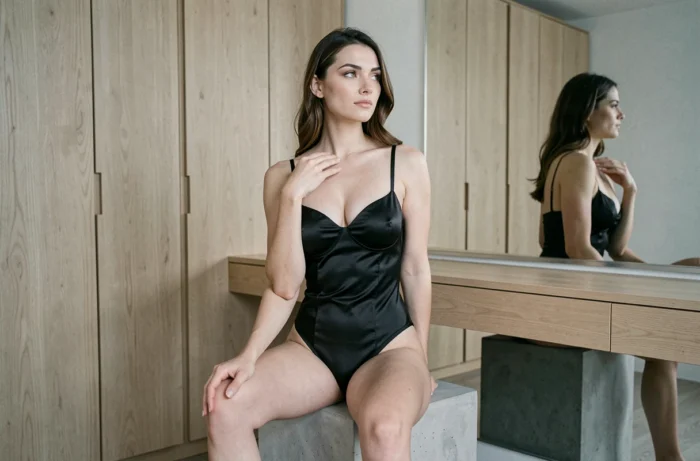
Low cut, high cut, or shorty: choosing the bodysuit’s bottom
The lower part of the bodysuit determines daily comfort and the overall look on the silhouette. Three cuts dominate the market, each with very different effects.
- The classic brief cut covers the hips and the top of the buttocks. It secures the fit and prevents the bodysuit from riding up. Suitable for body types with wide hips, it remains the most versatile for underwear wear.
- The high-cut style exposes more of the thigh and visually elongates the leg. It highlights slender silhouettes but may show under thin pants if the fabric is not smooth enough.
- The shorty cut descends over the top of the thigh and offers a light shaping effect on the belly and hips. This type of bodysuit works particularly well under a skirt or a straight dress.
A detail often overlooked: the crotch closure. Most bodysuits feature snaps or hooks at this level for practical reasons. A bodysuit without an opening at the crotch complicates daily life considerably, especially with prolonged wear. Checking this point before purchase avoids a common disappointment.
Lace, microfiber, or tulle: what the material really changes
The choice of textile determines both the visual appearance and the sensation on the skin. Each material has its own behavior that directly influences the comfort and longevity of the bodysuit.
Lace remains the textile most associated with seduction in lingerie. Quality lace is recognized by its flexibility and the regularity of its patterns. Rigid, cheap laces irritate the skin and deform after a few washes. Stretch lace, on the other hand, conforms to curves without compressing.
Microfiber creates a second-skin effect, smooth and invisible under clothing. It is the most suitable material for daily use. It dries quickly, does not mark, and retains its shape over time. Its drawback: a more technical visual effect, less sensual than lace.
Tulle plays with transparency and lightness. Combined with embroidery or satin bands, it creates an airy effect. Tulle alone lacks support and is mainly suitable for bodysuits worn as seductive pieces rather than as structured undergarments.
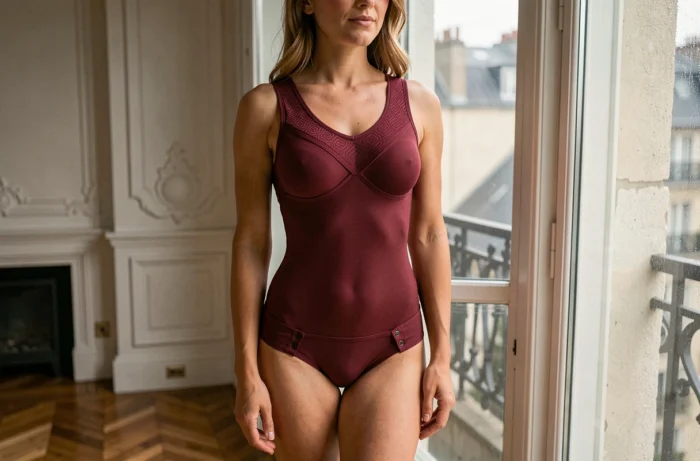
European textile regulations and lingerie bodysuits
A parameter rarely addressed in buying guides concerns the chemical composition of the textiles used in bodysuits. The European Union has adopted Regulation (EU) 2024/2462, which restricts the use of PFHxA and related substances (PFAS family) in clothing and accessories, including lingerie. This restriction comes into effect on October 10, 2026.
In practical terms, bodysuits that use water-repellent treatments or “second-skin effect” finishes based on PFAS will need to be reformulated or removed from the market. Product sheets will increasingly mention REACH compliance, which will become a selection criterion alongside cut or fabric.
For buyers, this means that a bodysuit sold after this date in the EU will offer better guarantees regarding the safety of materials in direct contact with the skin. Prioritizing brands that display the complete composition of their textiles now allows for anticipating this transition.
Care and durability of the bodysuit
A lace or tulle bodysuit should be hand washed or machine washed in cold water, in a lingerie bag. The dryer destroys elastic fibers in just a few cycles. A well-maintained bodysuit retains its support and shape significantly longer than a model that has been consistently tumble-dried.
The right lingerie bodysuit is one that combines appropriate bust support, a low cut consistent with the wardrobe, and a material with transparent composition. Trying it on with the intended clothing remains the most reliable test before any purchase.