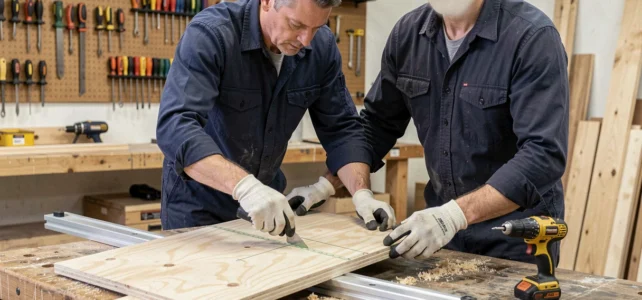
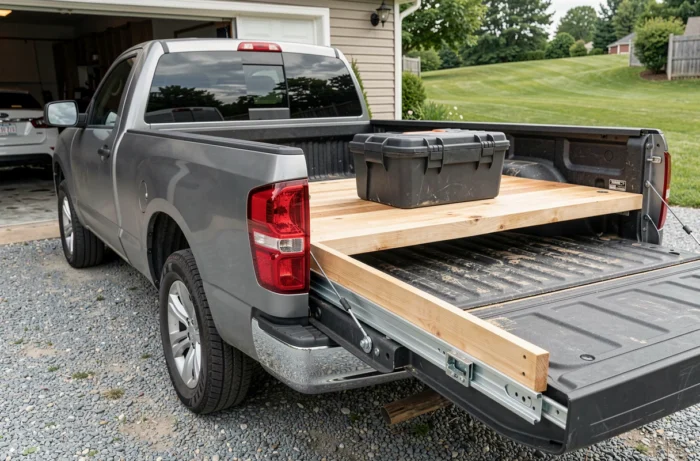
A sliding tray for a pickup is a panel mounted on slides, fixed in the bed, that pulls out towards the back of the vehicle to provide access to the load without crawling inside. The principle is based on a rigid tray and bearing rails, sized according to the internal width of the bed and the load being transported.
Friction sliding or bearing slides: the technical choice that conditions the entire project
Before listing materials, one must decide between two families of mechanisms. Friction sliding uses a material with a low coefficient of friction (high-density polyethylene, for example) that slides directly on the bed floor. No rails to fix, no drilling, disassembly in a few minutes.
The system with ball bearing slides offers smoother sliding and supports significantly heavier loads. The rails are fixed to the sides or the floor of the bed, and the tray rolls over them effortlessly. The downside: it requires drilling the bed or using existing anchor points, and the cost of quality slides represents the bulk of the budget.
For light daily use (camping gear, tools), friction on HD polyethylene is sufficient. For regular transport of heavy loads (generator, construction boxes), bearing slides are the only sustainable choice. This guide details the fabrication of a tray on slides, which covers the widest range of needs. Knowing how to make a sliding pickup tray with this type of mechanism allows for adapting the project to a simpler system if necessary.
Materials and sizing of the sliding tray
The tray itself
Marine plywood with a thickness of 18 or 21 mm is the best compromise between weight and rigidity for a bed tray. The panel should be cut with a few millimeters of play on each side to avoid rubbing against the wheel arches.
Measure the internal width of the bed at its narrowest point, usually at the rear wheel arches, and subtract about one centimeter. The length of the tray corresponds to the depth of the bed, minus the margin needed for the tailgate to close without strain.
The slides
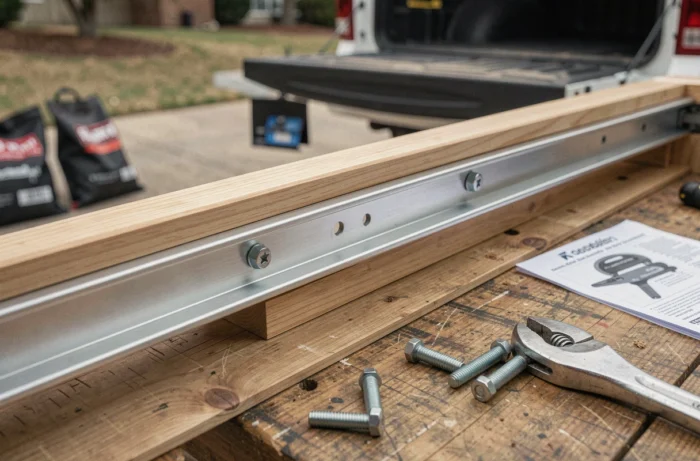
Full-extension drawer slides, with a load capacity suited to the expected weight, allow the tray to be pulled out over its entire length. Two pairs of slides (one on each side) distribute the load symmetrically.
The 20 mm Airline type tie-down rail has become the most common European standard for securing sliding equipment in utility vehicles. This profile allows repositioning the tray or adding anchor points without re-drilling.
List of main components
- A panel of marine plywood cut to the dimensions of the bed, sanded and treated against moisture
- Two pairs of full-extension slides, length suited to the depth of the bed, with ball bearings
- Stainless steel fasteners (countersunk screws, bolts, lock nuts) to withstand vibrations and corrosion
- Spacers or shims made of aluminum to raise the rails if the bed floor has ribs
- Rust treatment (primer + marine paint or varnish) for all drilled surfaces
Fixing the rails in the bed: drilling, corrosion, and alternatives
Fixing the rails is the step that generates the most hesitation. Drilling the bed floor exposes bare steel to moisture, and corrosion can become perforating in just a few seasons if treatment is neglected.
Each drilled hole must be deburred, then treated with a rust-inhibiting primer before the screw is installed. A seal (neoprene washer or polyurethane sealant) under each screw head prevents water from seeping in. On the underside of the floor, apply a layer of bituminous protection.
The alternative to drilling the floor is to use the original anchor points of the bed. Most recent pickups have threaded fasteners or integrated hooks, often numbering four or six. Steel or aluminum brackets can connect these points to the rails without touching the floor.
Securing the tray and safety standard NF EN 12195-1
An unsecured sliding tray becomes a projectile in the event of sudden braking. The European standard NF EN 12195-1 provides the reference framework: in an emergency stop, a load can be projected forward with a force reaching 0.8 times its own weight, and laterally or backward with 0.5 times its weight.
In practical terms, the tray must be locked in the closed position by a latch or pin system that can withstand these forces. A simple spring hook is not sufficient for a loaded tray. Two cam locks, one on each side, lock the tray in the rails and absorb the longitudinal force.
- Install a cam lock or lever latch on each side of the tray, aligned with an oblong hole in the rail
- Ensure that the locks fully engage when the tray is in the retracted position, with no lateral play
- Add a mechanical stop at the end of the rail to prevent the tray from coming out completely during extraction
This locking device protects both the contents of the bed and the passengers in the cabin.
Finishes and protection of the tray against wear
Marine plywood resists moisture but not repeated impacts or surface abrasion. Two coats of marine polyurethane varnish on the faces and edges extend the lifespan of the panel. A non-slip coating glued or painted on the top surface (textured paint like bed liner, for example) prevents the load from sliding when the tray is extended.
Lubricate the bearing slides at least twice a year with lithium grease to maintain smooth sliding. Dust and sand that accumulate in the rails are the primary enemies of the mechanism.
A well-built and properly maintained tray can be disassembled in a few minutes for a complete cleaning of the bed and can be reinstalled without adjustment. The initial sizing, choice of sliding mechanism, and anti-corrosion treatment of the fasteners alone determine the longevity of the whole system.