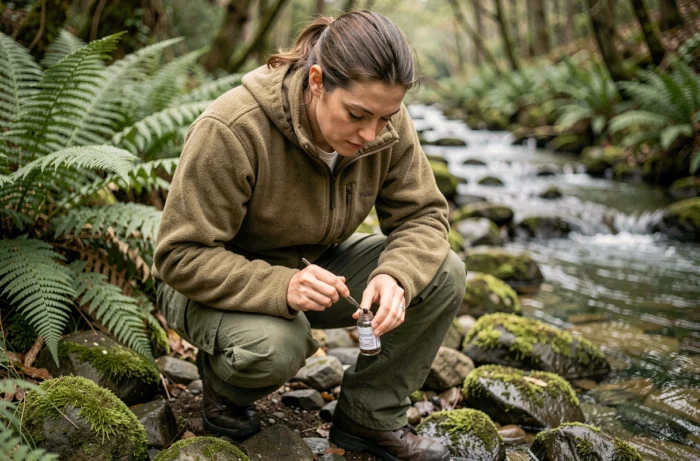
On the ground, when you turn over a flat stone in a humid forest and come across a small black cylinder a few millimeters long, you don’t necessarily think of an inventory tool. However, the droppings of the spotted salamander contain a wealth of information about the invertebrates present in the environment, and by extension, about the overall health of the ecosystem.
Diet of the Salamander and Feces Analysis
The spotted salamander is an opportunistic predator. It consumes whatever is within reach: earthworms, pillbugs, small beetles, slugs, spiders, springtails. This lack of specialization makes it a natural sampler of soil fauna.
When collecting its feces, you retrieve undigested fragments (elytra, mandibles, worm bristles) and, most importantly, residual DNA from the ingested prey. By consulting photos of salamander droppings, you learn to distinguish these droppings from those of other amphibians or small mammals, which is the first step before any serious collection.
Each dropping reflects the actual trophic interactions of the micro-habitat. A forest site where the feces contain a dozen different invertebrate taxa tells a different story than a site where only fragments of slugs are found. The diversity of prey remains serves as a proxy for the richness of soil invertebrates.
Metabarcoding of Feces: Field Protocol and Limitations
The most detailed analysis relies on metabarcoding, a technique for genetically identifying prey from DNA extracted from feces. Research conducted, notably at the Senckenberg Naturmuseum in Dresden on other vertebrates (turtles reintroduced in the wetlands of the Upper Rhine), has demonstrated the relevance of this approach: feces are collected, DNA is extracted, and then the diversity of detected prey is compared with the overall biodiversity of the environment measured by environmental DNA.
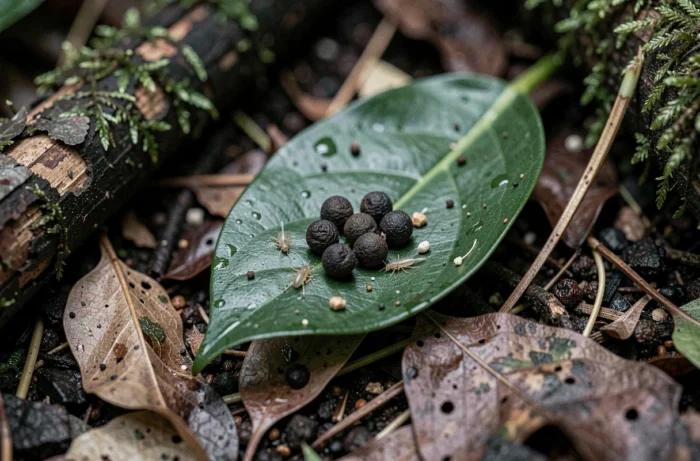
Applied to salamanders, this methodological framework is directly applicable. The salamander, active at night and confined to a limited area, provides a very localized view of invertebrate fauna. This way, a “trophic photograph” of the site is obtained, complementing traditional surveys (pitfall traps, litter sifting).
Concrete Steps for Collection
- Identify favorable micro-habitats: flat stones, decaying stumps, dry stone walls at the forest edge. Droppings are often found in close proximity to daytime shelters.
- Collect with nitrile gloves and a sterile swab in a dry tube. Avoid any contact with bare soil to prevent contaminating the sample with external DNA.
- Label each tube with GPS coordinates, date, and type of micro-habitat. Keep cool (field cooler) and transfer to the freezer within hours.
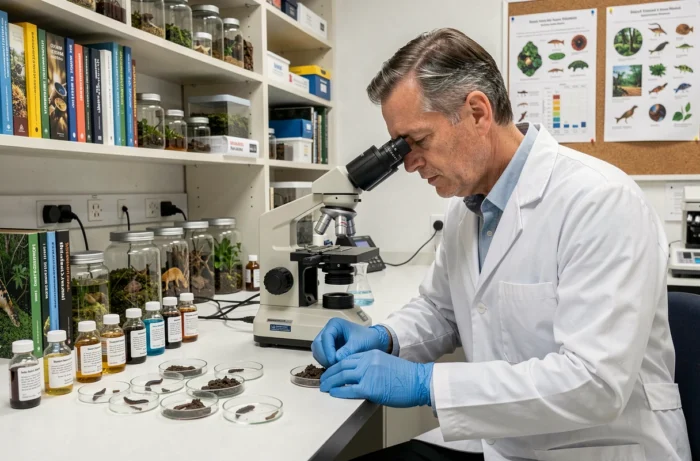
- For a simple morphological analysis (without a lab), examine the fragments under a binocular microscope and attempt to identify the major categories of prey: beetles, isopods, oligochaetes, gastropods.
Feedback varies on the quality of results from morphological analysis alone: some fragments are very degraded and difficult to assign. Metabarcoding remains significantly more reliable for compiling a complete inventory of prey.
Cross-referencing Fecal Data with Environmental DNA from Soil
The major interest of this method appears when two datasets are cross-referenced. On one hand, the feces provide information on what the salamander actually eats. On the other hand, an environmental DNA (eDNA) sample from the soil or water at the same site gives a broader inventory of the present biodiversity, including organisms that the salamander does not consume.
The comparison between consumed prey and available biodiversity reveals the degree of specialization or opportunism of the salamander at a given site. A marked discrepancy may signal a recent degradation of the environment: the salamander resorts to a reduced number of prey because others have disappeared.
This coupling of feces/eDNA has been validated in the context of the Senckenberg project on Upper Rhine turtles. Researchers measure the trophic impact of the reintroduced species on local biodiversity. There is technically nothing preventing this approach from being replicated on salamander populations in temperate forests.
What This Method Detects Better Than Traditional Inventories
Pitfall traps or litter sifting effectively capture mobile invertebrates on the surface. However, they underestimate burrowing species or those active only at night, precisely the favorite prey of the salamander. Feces complement traditional inventories by capturing the nocturnal and underground fraction of soil fauna.
Salamander as a Local Bio-indicator: Interpreting Results
In the field, one rarely seeks an absolute result. Sites are compared to each other or the same site at two different times. A forest plot where salamander feces regularly reveal more than a dozen distinct prey taxa likely has healthier soil than a neighboring plot where only three or four are detected.
The spotted salamander only moves within a few dozen meters around its shelter. This sedentary behavior is an asset: it provides a hyper-local reading, at the scale of a plot or a bank. Where an eDNA inventory of waterways captures diluted signals over hundreds of meters, salamander droppings anchor the information at a precise point.
- A site rich in varied prey (beetles, arachnids, isopods, gastropods, oligochaetes) suggests a forest soil that is little disturbed, with thick litter and stable moisture.
- An overwhelming dominance of a single taxon (slugs, for example) may indicate an imbalance, often related to pesticide use at agricultural edges or a gradual drying out.
- The complete absence of salamanders at a previously occupied site constitutes a strong warning signal regarding environmental degradation.
The presence of the salamander and the diversity of its diet function as a dual indicator: the animal signals that the environment remains habitable for amphibians, and its feces detail the state of the underground trophic chain. For naturalists or managers of natural spaces looking for a complementary tool to standardized protocols, this is a concrete, low-cost option that can be applied during the next nocturnal outing in a humid forest.